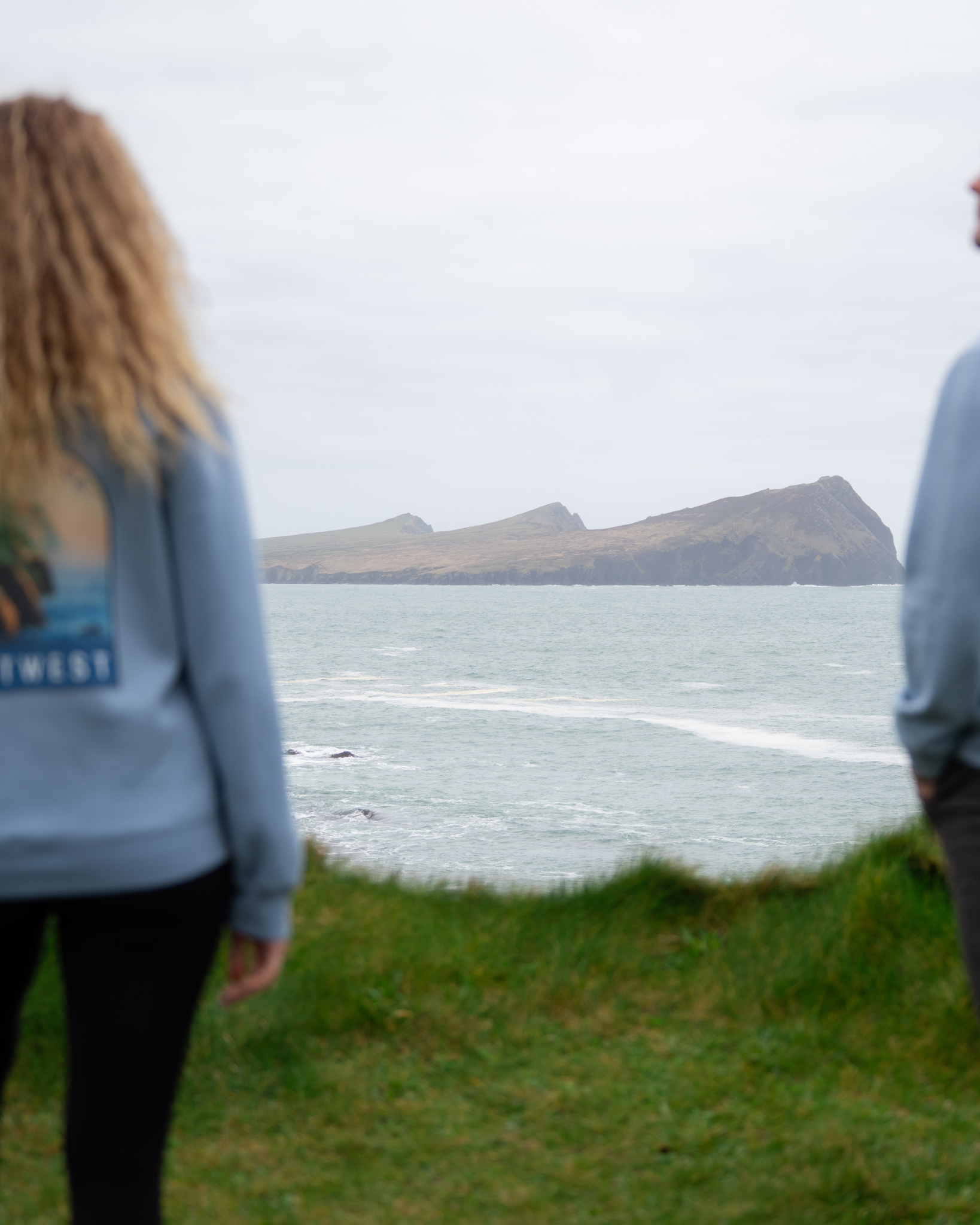


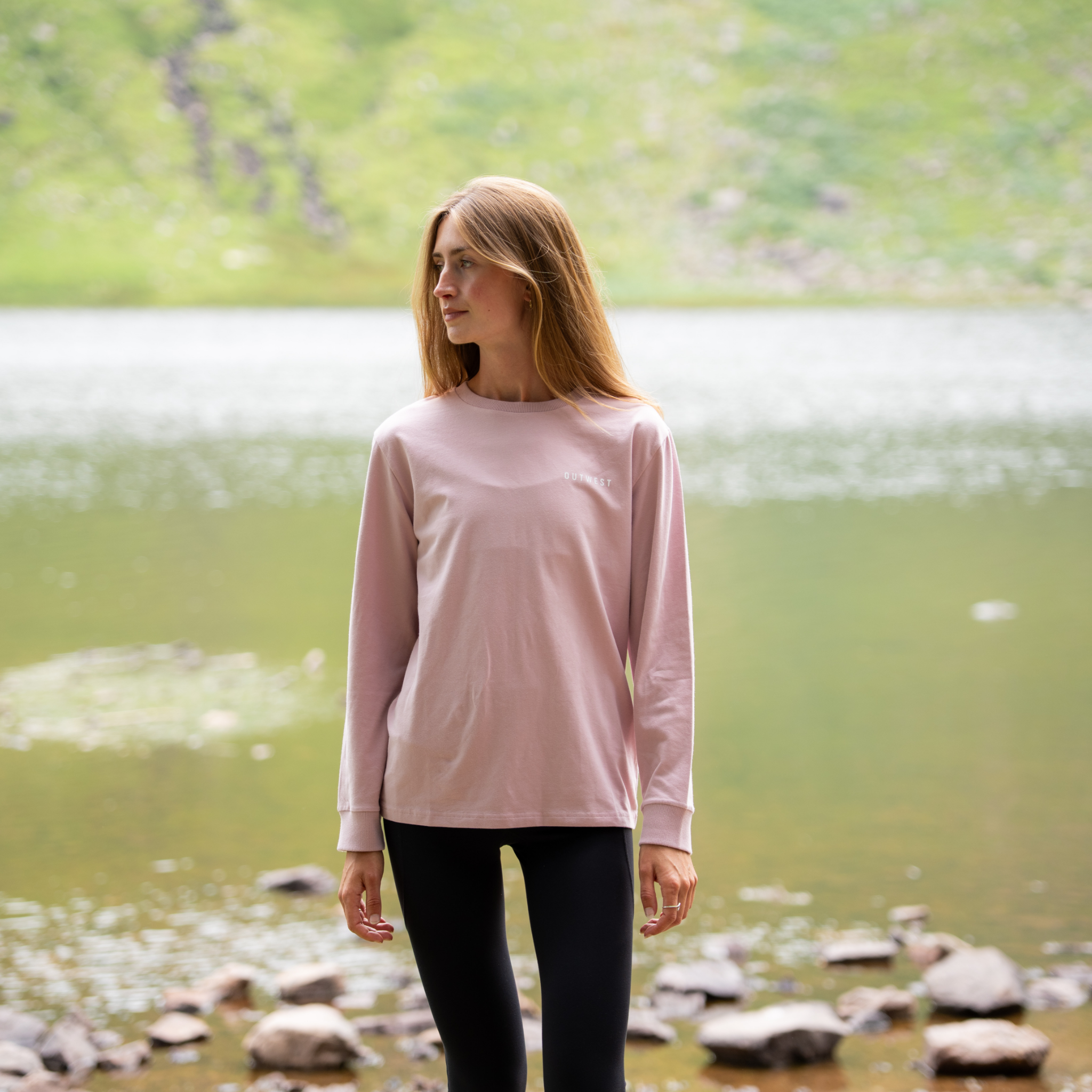




Earlier this year, Outwest announced a partnership with Maharees Conservation Association, launching a custom-designed long sleeve featuring their logo. For every long sleeve sold, we're donating €5 to support the incredible work they do.
Thanks to your support, it's become one of our bestselling long sleeves, meaning we'll be donating €1,200 to the association this month.
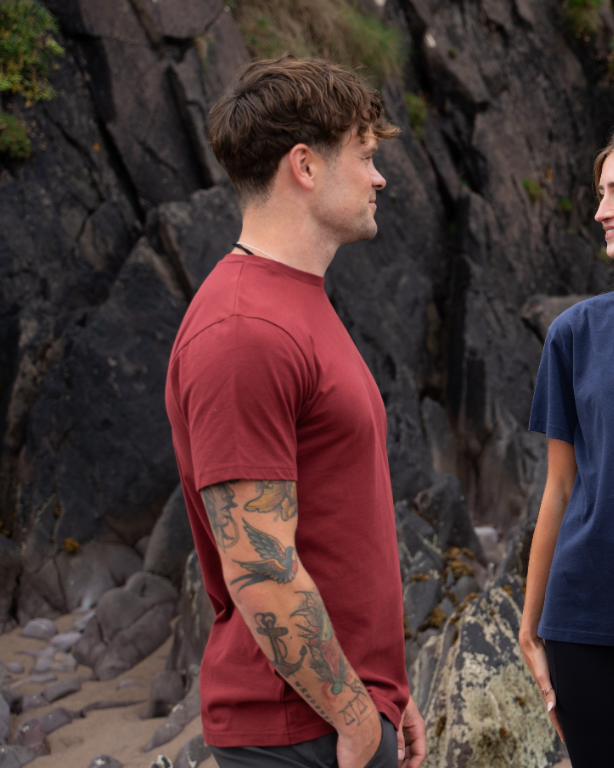
We recently spent a day with Martha Farrell and Katherine Syme, two of the committee's founding members, to hear more about the work happening on Maharees, how the association came to be, and what's next for the area.
If someone had never been to Maharees before, how would you describe it?
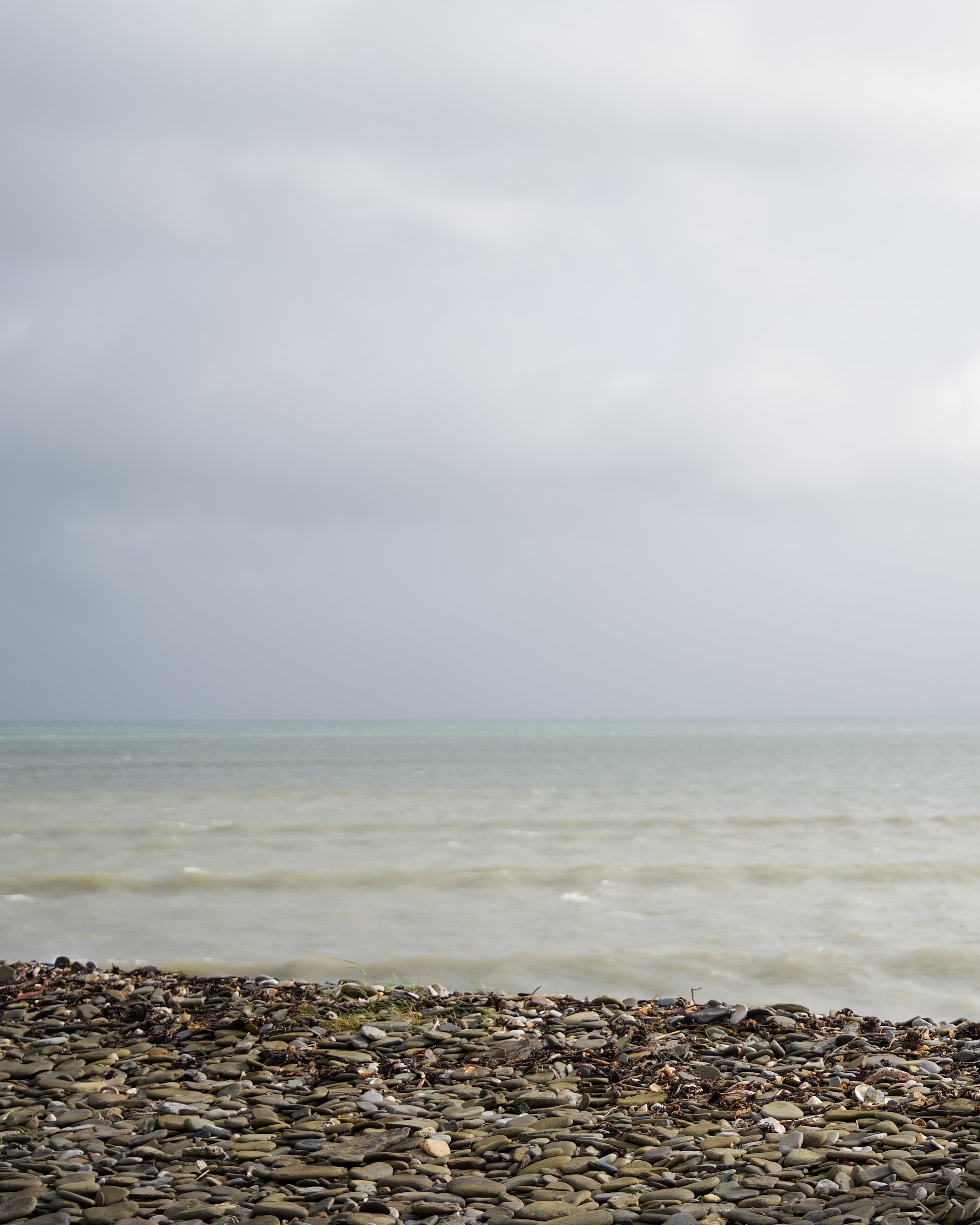
(M) Looking out over it now, it's a very special area geographically, it's a tombolo. If you look at the map, it's got this central sandy spit, branching out into two offshore islands, part of the wider Maharees archipelago.

(if you’re wondering what a tombolo is - it’s a natural sandbar or ridge of sediment that connects an offshore island to the mainland. In this instance, Maharees are made of sand).
(M) Then it has this extensive dune system dominating the tombolo, so driving down the road, either side of you it's just marram grass blowing in the wind, hills of blown sand. Three bays sit in close proximity to you at all times. It's a feeling of being on an island without quite being on one. And because it's commonage, the land isn't fenced off, we don't have a lot of houses built into the dune system itself, you have horses roaming around, so it has that feeling of wildness.

Maharees
(K) There isn't anywhere else quite like it in Ireland. It has rare species, including the Natterjack toad, and an abundance of seagrass on the seabed rare enough that American scientists came out a few years ago to study it, with a committee member diving with them to see it firsthand.
As a destination: if you like the outdoors and being active, there's everything here - walking, fishing, cycling, swimming, surfing, windsurfing, foiling, hiking, plus the pubs and food. Good for an action-packed family holiday.
As a place to live: it's a great place to raise children, away from a lot of the noise of the world, though winters are long, windy, and genuinely bleak; it's not for everyone. Only 297 people are listed as permanent residents here and most of us wouldn't change it - though often take a week or two away each winter to break it up.
(M) There's a real sense of peace here too. Even on a day like today, with a lot of visitors around, there's still a silence to it. It's busy now, but it doesn't feel it.
We also have the longest beach on the west coast of Ireland, Brandon Bay, I don't think it could ever feel full. You'll always find a spot on your own. And then you have the drama of the mountains, Brandon to the west, Beenoskee to the south, Caherconree to the east.
Because it's remote, traditions passed down through generations are still ongoing: the wren, the regatta, currach racing, currach-making, fishing, vegetable growing. We have a 13th-century church, with a 6th-century cross-slab inside it. And off the coast, Illauntannig, an island with an early monastic site.

Brandon Bay
How did Maharees Conservation Association come about?
(K) Between 2014-2016 we had really bad storms. Sand was blown onto the road at least twelve times, and the Council had to come out and clear it so people could get to work. The Winter of 2014, the road out at Kilshannig got taken away entirely, when swell direction, swell size, wind direction and gale force winds all combined at once, the worst possible conditions you could imagine.
(M) Between 2015-2016 was when storms were first named in Ireland, I'll never forget them: Desmond, Eva, Frank, Imogen - all genuinely damaging storms. Desmond in December 2015 brought a red rainfall warning, we've never had one since, a huge volume of rain in a short space of time. Later storms brought rain too, but the wind was what drove the sand onto the road. I think we got as far as Katie that year in the naming order.
(M) Hearing storms named creates an anxiety around them, which is needed, we do need to prepare, secure the house, expect power outages. But I could never remember a winter like that before, and people started really wondering, is this the future?
In the weeks after, the road was getting blocked almost daily, sand blowing up over the dune, people queuing to get home, nobody really knowing what to do about it, the local authority just clearing it constantly. It was a crisis. We were advised by Dr Eugene Farrell from NUI Galway that we needed to organise properly as a community.
(K) So in February 2016, we held our first community meeting in the clubrooms. Martin Lynch chaired it and out of that meeting, we formed our original committee of fifteen members and became Maharees Conservation.
(M) It's one of those things, if I hadn't gone to that meeting, it changed everything for me over the last ten years, for the good.

How important has the community been to creating the Maharees Conservation Association, and how do you all work together?
(K) The community existed before the conservation work started, but before that Winter, there wasn't a shared focus before. Now people genuinely understand what's special about the place and want to protect it. When there's a fire or an emergency, a message goes out on the WhatsApp groups (Maharees Conservation, biodiversity, general community) and before you know it, fifty people show up, sometimes within minutes.
There's a generational element too: some older residents who aren't on social media are slower to see what's changed, but younger people, students especially, are increasingly doing school projects on the beaches and dunes. One recent project ("Shoreline Shapers") made it to a national environmental science final in Dublin, with the local Transition Year students doing a project with us.
Before the committee was even formed, the beaches were covered in litter, a lot of it marine waste: rope, bottles, gloves. In the early years we ran huge cleanups with soccer clubs and schools involved, groups of fifty, tractors and trailers hauling bags off the beach. That was clearing years of buildup. Now it's just maintenance.
Getting a committee that actually works together is the hardest part, people usually have different views. Ours has just always gelled. A few people have stepped back over the years and new people have joined, but there's never been friction. Everyone gravitates to what they're best at or most interested in.
A typical busy week might mean several nights in a row getting fencing up. What used to take much longer now takes about three nights with proper tools (stake drivers, hammers, nails) funded through grants, which is brilliant.

Marram grass planting on Brandon Bay
How is Maharees Conservation Association funded?
(K) Funding comes through the local authority, Kerry County Council and state agencies e.g. Creative Ireland, the Heritage Council, NPWS, BIM Flag, River Basin Management Service, MTU, Clean Coasts. Grants are usually earmarked for a specific purpose, for example funding secured based on an application for chestnut fencing has to go on chestnut fencing. So that makes day-to-day running costs, accountants, insurance, general admin harder to cover. Having some money in the bank from unrestricted donations really helps us secure further grant funding too.
We run a table quiz twice a year, teams of four, that brings in some additional cash, our main source of unrestricted funding for day-to-day running costs. Everyone comes together for that and it’s always great fun.

Beach Clean on Béal Geal
What types of grants do you rely on?
(M) Oh, we apply for everything! We have to. The Heritage Council, Kerry County Council, Creative Ireland, Community Foundation Ireland. BIM FLAG just gave us funding for a project on the tradition of currach racing, we're getting two racing Naomhógs and trailers to bring to competitions, aimed at supporting young people to get involved in the tradition if they don't own Naomhógs. We're also making a short film about Naomhóg racing, the Maharees Regatta committee just ran an excellent Regatta here a couple of weeks ago, it was fantastic.

Naomhóg building
We also apply to the River Basin Management Service, Clean Coasts, An Taisce, the National Lottery a long list and that's not even including free expertise we have benefited from through MTU, University of Galway, Irish Wildlife Trust Kerry, NPWS and others. Plus the quizzes, the donation boxes, and funding like the Outwest partnership. Most grants are ring-fenced, you can only spend it on what you applied for. Funding that is not part of a grant application process like that is a breath of fresh air, it gives us flexibility, lets us build a bank of funding so we're not stressed about having cashflow to cover the grants before we draw them down.
(K) We also got Creative Ireland Creative Climate Action funding about three years ago delivered in partnership with the Dingle Hub, working with local artists to build awareness of the future impacts of climate change on the area and how we can adapt. One of the outputs of this was a seven-part podcast series called Will it Stay Fine which was funded by Community Foundation Ireland and DCEE. We've since been part of another successful Dingle Hub application to the Creative Ireland Creative Climate Action fund, for another three-year project on the topic of food security.
And everything is volunteer-run?
(M) All volunteers. We have a board, fifteen members who are directors, giving oversight. Off that we have our subcommittees.
(K) We now run five subcommittees: the Heritage team: looks after the cultural heritage side, including a self-guided Heritage Trail app funded by the Heritage Council. The Biodiversity team run nature walks covering flora, fauna and sea life. The Dune Management team handles fencing, marram grass planting, and general dune protection. The Beach Cleaning team organises beach cleans and the Climate Adaptation team is now finalising the completion of our Community Vision and Climate Adaptation Plan and will oversee the implementation of it.
What about the dune management - how does that work?
(K) So one of our members found chestnut fencing, which we didn't know about before, but now use everywhere. We did three engineering drawings for three rows of it where the dune was blowing sand up onto the road. The three layers trapped the sand in its path: they stopped it reaching the road, rebuilt the bank, and let us plant marram grass on top, which then held more sand and built the dune back up naturally.

Chestnut Fencing being put in place on Brandon Bay
The first winter, the fencing (about three feet high) was completely covered. The next winter we added another three rows on top of that, so it acts a bit like a foundation. After that the dunes regained their shape on their own, we just assisted. We haven't had to touch that stretch since. We also planted marram grass through this section, which built the bank up further.

Planting Marram Grass on Brandon Bay
(K) Another thing we did was put up fencing to create a single path to the beach so we could keep footfall in one place. We then had to run a "camping committee" every summer night for five or six seasons, moving people on.
Where we're standing now used to be a campsite, cars, tents, everything, ten years ago. We weren't popular back then, people loved coming here to camp, but we had to protect the dunes. Now it's rarely needed since most people know the rules; the odd person who doesn't know the area still chances it, but they get moved on quickly. Maharees is on the map now, so gets a lot of tourists who don't know or understand the reason behind it. The signage helps a lot.

What's changed from a tourism perspective, and what level of awareness has passed on to visitors?
(K) More visibility has brought more day-trippers, and some spots couldn't handle the volume. One landowner makes a field available to the Council for summer overflow parking. The Council also added double yellow lines after cars parking everywhere on the roads became a genuine hazard - an ambulance had difficulty in getting through due to so many cars being parked along the road. This year a new Interreg Atlantic Area co-funded pilot shuttle bus service started (a collaborative project led by MTU, involving Maharees Conservation, Kerry County Council and Failte Ireland), connecting Castlegregory to Maharees, aimed at cutting down on car traffic to the area for a more sustainable tourist destination.
(M) Since starting out, even we have learned a lot we didn't know before. For instance, if you walk ten times over a sand dune, the vegetation holding it together dies, and then the sand is free to blow away and you start seeing net erosion. Once we understood that, we started fencing off the delicate parts of the dune that were defending the road from storm surges. This is why raising awareness of sticking to the paths is so important. I think our visitors know that now too.

(M)There’s also growing awareness that Maharees supports an incredibly rich biodiversity: bee orchids you won't find just anywhere in Ireland, the Natterjack toad, our only native toad, red-listed, and we're the population stronghold for it. A diverse range of butterflies too, and in Tralee Bay, critically endangered skate and other elasmobranch species, including cat sharks. That awareness wasn't there ten years ago. I think experience-led events over the last eight years or so have been key to explaining not just the "why" behind fencing off the dune, but understanding this place on a much deeper level. That was the secret to a lot of it.
What is the outlook on Climate Change impact on the area, and Ireland as whole?
(M) Everyone realises Ireland's climate is changing. We'll see warmer, drier summers, more precipitation too, but also spells like this, and when we get nice weather in Ireland, we want to go to the coast.
(M) The National Climate Change Risk Assessment, released last year by the EPA, says we'll actually see fewer windstorms overall, but more intense ones when they do happen, more storm-force winds, more rainfall (and harder to predict exactly where it'll hit, since it can drop in huge local volumes), warmer, drier spells in summer like this one, and a one-metre sea level rise by the end of the century, which will actually change the map of Ireland. We'll lose parts of the coastline to inundation, and Maharees won't escape that, being a low-lying tombolo.
With Storm Éowyn last year, we were lucky it didn't coincide with a high or spring tide, it would have done far more damage if it had. Storm Darwin, back in 2014, took metres off the coastline because it did coincide with a high tide. We've been getting away with it for the last ten years.
How is Maharees Conservation Assocation working to combat climate change?
(M) Over the last couple of years, through a Creative Ireland project with the Dingle Hub, we've been working on a climate adaptation plan by bringing all the state agencies together. We have done a lot of consultation with our own community, put forward the objectives that came out of it, protecting our wildlife, our sense of identity, our cultural heritage, our built heritage.
(M) As visitor numbers to the coast increase, we'll need systems in place, and we already have some: a temporary car park from the local authority, signage, fencing protecting the parts of the dune that can't withstand trampling. In the last year we've also been working on a ringed plover project, raising awareness that we have breeding waders along the coastline.
With the hot and dry weather in Ireland, we've been seeing more and more fires happening, recently in Killarney, Wicklow, Tipperary, but also here in the Maharees. What's been happening?
(K) A recent fire started here, what we think was a disposable barbecue left behind while still hot; the land and everything around it was so dry, it all caught. The fire brigade came to put it out, but it reignited that night and they had to come back, this time struggling to get water to the site at all because of how remote the location is.
(K) A similar fire three years earlier spread very quickly toward a nearby house. Marram grass across the Maharees looks green, but is really dry at the base and burns like straw. Wind makes it spread faster too; we were lucky there wasn't much wind blowing on either occasion.

Maharees Fire, 2023
What advice would you give visitors of Maharees, or anywhere else, to respect the outdoors and the place they’re visiting?
(M) I would say learn about the place you're visiting, care for it as if it were your home. We have a lot of information on our website and socials about events and guided trails, that gives good insight into the place and how to care for it.
If you're visiting Maharees, our main messages would be about taking care when visiting a sand dune system: don't camp in a Special Area of Conservation. Many sand dunes like ours across Ireland are special areas of conservation, important at a European level for the wildlife they support. One camp site might look harmless, but when that becomes hundreds of campsites over the course of the summer, real damage is done, particularly to species at risk like the Skylark or the Natterjack toad. Because wildlife hides from predators and humans, it's just not always visible to people who are not aware of it and wouldn't want to harm wildlife. I would also say don't light fires, stick to the paths, keep dogs on leads. These are basic things, but they make a big difference.
In the context of the recent fires in Killarney National Park, fires really aren't a good idea, even a beach fire in the middle of the sand, a spark from something that seems innocuous can devastate a high-nature-value area like this. Stay sensible: don't camp, don't light fires, stick to the paths, keep dogs on leads. Four basic things, but they make a big difference.
(K) Another thing here is that we’re practising regenerative tourism, giving our visitors a way to give back: whether that’s buying local products, donating to our charity to support programmes, joining a marram grass planting session or a beach clean (we're actually doing a big one together on the ninth of August), or buying one of the Maharees Conservation tops! We have donation boxes in a lot of the restaurants too, just giving people an opportunity to support a place they love visiting.
As awareness is growing of your work, what has been some of the impact you've directly seen come from it?
(M) I think unity has really been the success story of this organisation, because resilience is about how you bounce back from what climate change will bring, and our strength over the last ten years has been community effort. Everyone has their own version of how they want Maharees to be, different agendas at play, always, but I think people understand that having a community organisation as a platform for that conversation has been valuable.
(M) At the moment it’s ringed plover nesting season on Brandon Bay, and this time last year there'd probably have been twenty or thirty cars on the beach. If you're walking, they will try to lead you away from the nest, so there's a chance of not disturbing it. But if you're driving, the birds have no chance. All week, not one car on the beach, everyone made the extra effort to park further away and carry their gear down. That's the kind of impact I love seeing.
We worked with the local secondary school, Mean Scoil Nua an Leighriuigh, a group there wanted to do something for the EcoUNESCO Young Environmentalist Award, and they put together a set of awareness-raising initiatives, including a ringed plover workbook. So when the breeding waders team came to put up signage, the community already knew about the bird.
I think the kids started the momentum, really, the secondary school group went to Dublin and won the overall senior award, which was fantastic, kids from the area being recognised on a national stage. We also put up a sign, "children at play, please don't park on the beach," and briefed the windsurfing community directly, since we have members of that community on our team. It's been an amazing behaviour change in the space of a couple of months.
We've seen people not driving on the beach, reporting nest sightings, visitors too, taking note of nest locations and telling us. It's a coming together of different communities, and communities of interest, who value this place.
Last thing I'd add is we're also the first and only Irish case study on the EU's Climate-ADAPT platform, showcasing good examples of resilience and adaptation in Europe. Being asked to talk and share our story, like I'm doing with you now, that tells us what we're doing is good.
If everyone reading this could know or remember just one thing about Maharees, what would it be?
(K) My lasting piece about the Maharees, I think it's how it makes you feel. There's a peace here, a wildness, that's the opposite of the fast-paced, results-driven, everything-measured world we live in now. But out here, looking at the mountains in the distance, it's that sense of peace you get from being here.

(M) We're trying to keep this place in as good a state as we can, for as long as we can. We're not naive, this tombolo will be changed utterly by climate change eventually, over the next few hundred years. I don't know how much of it will be left, honestly. But while we're here, we want to see it respected, and I think that is happening.
(M) The vision is that the community is protected and helped to adapt to climate change, that we protect our natural and cultural heritage, that we have systems in place for visitors to enjoy the place while understanding its fragility, and that we keep working together.

If someone wanted to get involved and support, how can they?
(M) They'd come along to a Heritage Trail walk, or join a beach clean, and everything's on the website and socials. Follow on Facebook and Instagram. Everything's free to attend. And you can donate on the website, or get one of the Outwest Long Sleeves!
We run a series of events every summer, it could be elasmobranch ID, a heritage trail walk, or this summer, lovely sound walks with local artists through the Creative Ireland fund. Three artists lead it, you put on headphones and walk a scenic route listening to recorded interviews and sounds from Maharees. It's through those events we meet our visitors and build a relationship with them.
Coming up: we're hosting a beach clean here with Outwest on August 9th. We'll be starting at 11am, meeting at the overflow car park at Magherabeg on Maharees, and heading on the beach clean along Brandon Bay. We would love as many people to come along as possible so hopefully see you there!
Learn more: Maharees Conservation Assocation Website